

Protecting the skin of people with albinism is a global challenge. Commercial photoprotectors (sunscreens) have been tested to be insufficient given the local and cultural conditions of Sub-Saharan Africa; therefore, addressing this challenge and designing long-lasting solutions requires coordinated action, scientific backing, field knowledge and the expertise of industry leaders.
Our joint history of cooperation
Our relationship with BASF began in 2011, the year in which the world-leading chemical company started collaborating with the Regional Dermatology Training Centre (RDTC) in Moshi, Tanzania, to expand the production of its sunscreen product, Kilimanjaro Suncare. In 2014, Mafalda and Lorea, pharmacists and founders of Beyond Suncare, began working directly with BASF’s experts, contributing our field experience with the objective of developing a new and more effective formula that responded specifically to the needs and preferences of people with albinism in Sub-Saharan Africa.
By 2016, BASF developed a second version of this formula with improved properties and optimized to lower the impact on the environment using BASF’s EcoSun Pass technology. Since then, its technical contribution has been continuous through performance test measurements, the transfer of knowledge and the supply of raw materials and UV filters completely free of charge.

The value of the field and technical expertise
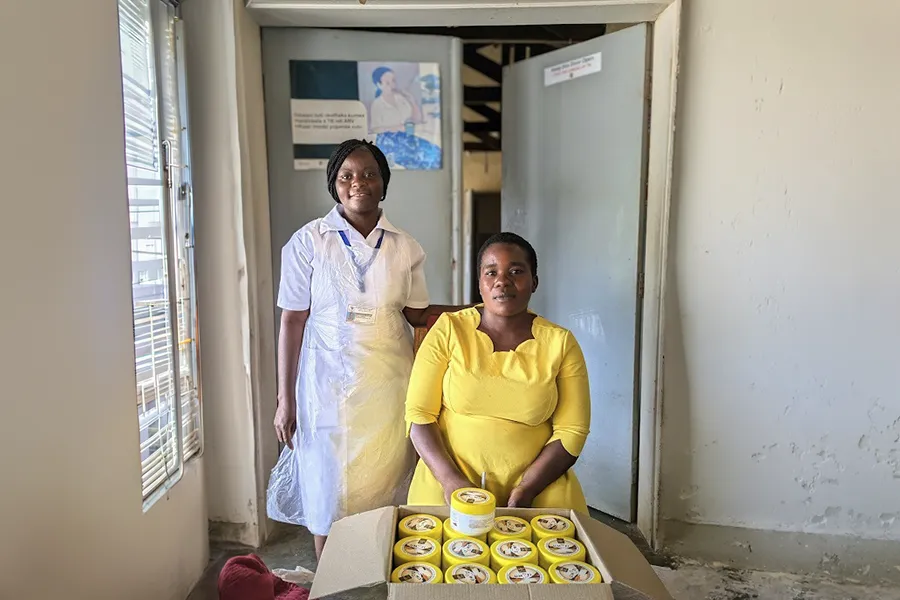
Umozi MAX, our sunscreen, is the direct result of combining the technical information gathered by our team on the ground with technical expertise and formulation knowledge within BASF’s laboratories in Grenzach-Wyhlen (Germany). Most of the people with albinism we serve live in African climates that can fluctuate abruptly from high humidity to drought, and with high or very high solar radiation (extreme UV Index). To respond to these extreme weather conditions and guarantee that the cream is not lost through perspiration, BASF applied Switch-Oil-Phase (SWOP) technology.
SWOP emulsions are technologies capable of transforming from an O/W (oil-in-water) emulsion to a W/O (water-in-oil) emulsion during application itself, offering the best technical compromise between sensory properties, stability and water resistance:
-
O/W Phase (during application): Provides a pleasant and fresh distribution, leaving a light, non-greasy and fast-absorbing feel with an immediate cooling effect.
-
W/O Phase (after application): Guarantees a prolonged moisturising effect, long-lasting skin care and high protection against external influences. Furthermore, W/O formulations are superior for repairing and protecting the skin barrier, as they immediately create a protective layer over the stratum corneum.
Thanks to observations obtained on the ground, we validated that the slight whitening effect on the skin is not seen as a disadvantage by local users, but rather the opposite, as this colour acts as a visual guide that helps them apply the formulation in a completely homogeneous way. Along the same lines, we transformed the original fragrance-free formula into a version with a hypoallergenic fragrance. Optimising the sensory profile is vital for the user, as a pleasant usage experience promotes regularity in application and guarantees long-term therapeutic adherence.
Scientific rigour and formula specifications
The formula of Umozi MAX SPF50+ rigorously complies with the European Union recommendation regarding the UVA protection value (UVA-PF/SPF > 1/3) and demonstrates absolute photostability across the entire ultraviolet spectrum. We combine water-soluble and oil-soluble sunscreens to achieve an optimal balance between high protection and a pleasant sensory experience. The use of full photostable UV filters avoid the accumulation of free radicals and severe allergic reactions by protecting both phases of the emulsion through absorbance and scattering mechanisms.
The total UV-filter load has been strictly limited to 14.5% photostable filters to prevent any adverse reactions of photofragments, and is based on high molecular weight filters provided by BASF:
-
Tinosorb® S (Total Shield): A maximum efficiency filter that covers the entire spectrum (UVA and UVB) from the oil phase, supporting homogeneous protection against sunburn and ageing.
-
Tinosorb® M (Ultra-UVA Barrier): Microfine particle technology in the water phase that absorbs and scatters UVA and UVB radiation, focusing on long UVA. It is the ultimate specialist against blemishes and photo-ageing.
-
Tinosorb® A2B (Broad-spectrum): A high-performance broad-spectrum filter that seals the critical gap between UVB and UVA 2 rays.
-
Emolients (Cetiol® CC, Cetiol® C5): Incorporated to optimise the sensory profile.
In terms of stability, Umozi MAX SPF50+ successfully passes the standard testing for cosmetic formulations, meaning no phase separation (demix) or recrystallisation of the UV filters is observed, confirming its stability even at elevated temperatures of up to 50 °C.
Efficient design focused on local production
The sunscreen was not only designed to maximise its medical efficacy, but also to facilitate its direct production in the countries where we work. The manufacturing instructions developed alongside BASF reflect a simplified and optimised process thanks to a straightforward formulation that relies on a limited and essential number of raw materials provided by a single supplier to ease logistics and the supply chain. The hot-cold manufacturing process is efficient, repeatable, stands out for its low energy consumption and does not require specific storage conditions for the raw materials or the intermediate product.
For the packaging, we prioritised a sustainable and recyclable solution, selecting a simple open-jar format that is much easier to wash, recycle and reuse in the field. For the product to suit this type of packaging, the formulation was deliberately designed with a high viscosity. The operating system works through the exchange of empty packs for new filled ones, which ensures a continuous and regular supply whilst maintaining a constant channel of dermatological monitoring with the population. This simplicity in the manufacturing processes allows us to plan and advocate for establishing a local production system that eliminates dependency on external suppliers.
Clinical validation of results
The efficacy of this technical cooperation was refrended in a dermatological study conducted in Malawi with 210 participants with oculocutaneous albinism, whose sample presented an average age of 24.5 years and an equal 50% male and 50% female split.
After four months of continuous use of Umozi MAX SPF50, medical evaluations determined that the proportion of participants with no facial sunburn increased drastically from 40% to 90%, a process that was accompanied by our photo-educative programme and routine skin check-ups. At the end of the study, the formula achieved 100% approval and acceptance from the users, proving that science, technical rigour and rigorous field information are a clear pathway to saving lives sustainably.
For this model of local production and dermatological care to continue expanding and protecting more communities in Sub-Saharan Africa, continuous support is vital. You too can be part of this structural change; join Beyond Suncare.
