

Research, Equity and Prevention: What Cancer Epidemiology Teaches Us About Skin Cancer and Albinism
A conversation with Dr Valerie McCormack (IARC/OMS)
Skin cancer is, in most cases, preventable. However, for many persons with albinism—particularly in low- and middle-income countries—it remains a leading cause of illness and premature death. Following the World Forum on Skin Cancer Prevention and Management in Persons with Albinism, held in Cape Town, we spoke with Dr Valerie McCormack about how cancer epidemiology research can help us move towards fairer and more effective prevention.
A career deciphering cancer inequalities
Dr McCormack is a world-leading cancer epidemiologist. Her work focuses on understanding how environment and lifestyle influence cancer risk, especially in low- and middle-income settings. Her approach is clear: it is not enough to know that cancer exists; we must understand the social and economic barriers that prevent a patient from being cured
Key takeaways: Research into action
1. The Weight of Inequality
In sub-Saharan Africa, skin cancer is not merely a medical issue but a symptom of profound social inequality. Persons with albinism often face what she describes as an “accumulation of disadvantage”:
- Economic Barriers: The cost of transport to reach a specialist hospital or the price of diagnostic tests can be insurmountable for a family.
- Lack of Awareness: Early symptoms are often ignored due to a lack of information, leading to diagnoses at advanced stages when treatment is more complex and costly.
Overburdened Systems: Under-resourced hospitals often prioritise other infectious diseases, leaving this community overlooked.
“For a programme to work, it must be adapted to the local context, be affordable, and be integrated into the public health system,” McCormack states.
-
2. The Urgent Need for Current Data
One of the major hurdles we face is that 40-year-old statistics are still being cited today. Valerie emphasises the urgent need for modern studies—similar to the ABC-DO breast cancer cohort she led—specifically focused on albinism.
What is the real purpose of this scientific research?
- Identifying Causes of Mortality: We need to know precisely how many people die from skin cancer and at what stage of treatment they are “lost”.
- Convincing Decision-Makers: Data is the language of governments and major donors. With solid evidence, we can demonstrate that preventive interventions are cost-effective and save lives on a massive scale.
- Improving Quality of Life: It is not just about survival, but about living without the physical and psychological scars left by aggressive surgeries when cancer is detected too late.
3. Strategies That Work: From Theory to Practice
It is not all challenges; there is also hope. During the Forum, several initiatives were highlighted that Dr McCormack views with great optimism because they directly tackle barriers to access.
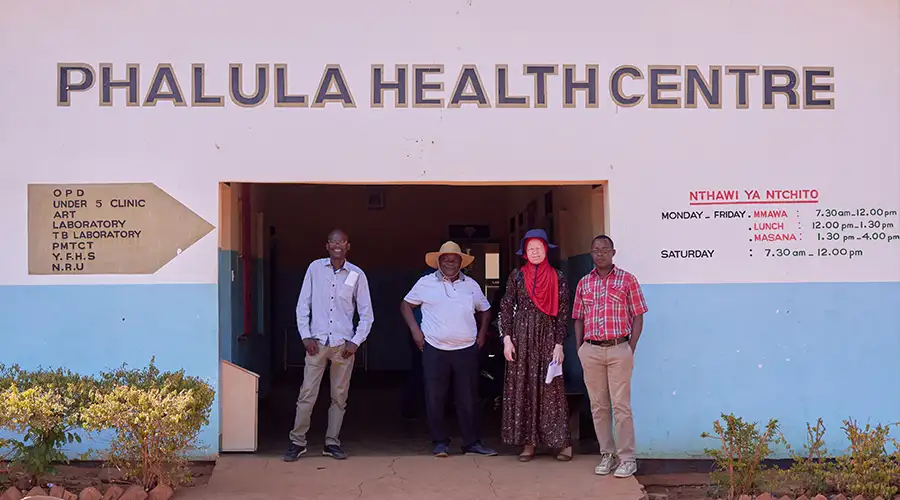
- Mobile Dermatology Clinics: Valerie stresses the importance of bringing medical care to the people, rather than the other way around. At Beyond Suncare, we have been driving these clinics for years in remote areas of countries like Malawi and Rwanda. Through this deployment, thousands of people have received regular screenings, preventing minor lesions from becoming incurable tumours due to a lack of transport or resources.
- Teledermatology: Using technology to connect experts with patients in isolated areas is a key tool for the future. By digitalising follow-ups, we reduce waiting times and ensure more accurate diagnoses in less time.
- School-Based Surveillance: Integrating skin checks into school programmes is vital. Detecting sun damage in childhood allows for intervention before the damage becomes irreversible.
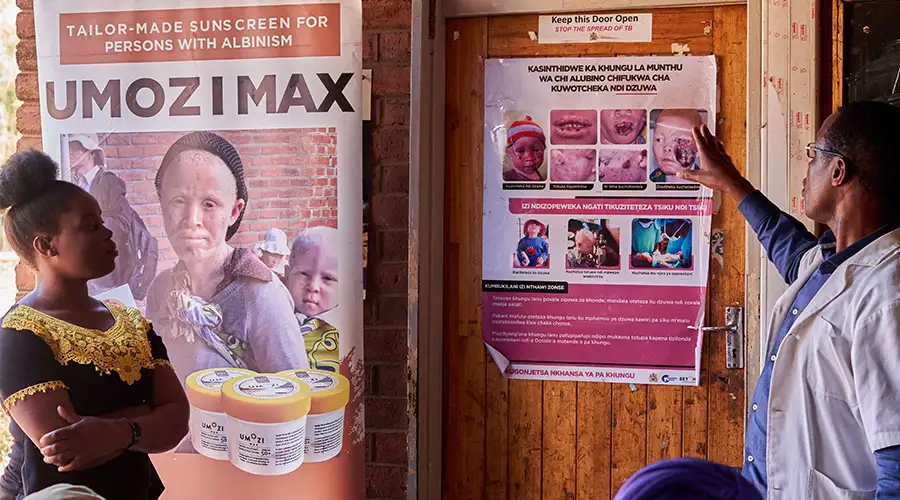
- Universal Access to Photoprotection: For Dr McCormack, primary prevention is the bedrock. Therefore, our work in the local distribution of our Umozi sunscreen is fundamental to ensuring that protection is an accessible right for all.
Key Conclusions: Cancer and Prevention
Dr McCormack’s intervention provided three fundamental lessons for the future of the fight against skin cancer, reinforcing the roadmap we follow at Beyond Suncare:
- If there is no data, the problem is invisible: Work is underway with the African Cancer Registry Network to make albinism a mandatory variable. At Beyond, we are committed to this transparency, recording every case treated in our clinics to build the clinical history that is currently missing in many countries. If albinism appears in official statistics, it will appear in public budgets.
- Vulnerability as an Opportunity: Unlike other genetic cancers that are hard to detect, persons with albinism are easily identifiable for early screening programmes. “That physical vulnerability is also our opportunity to act in time,” she notes.
- The Bridge Between Science and the Patient: Civil society is the engine of change. As the doctor rightly points out, organisations like Beyond Suncare are the essential bridge. Without local knowledge and NGO advocacy, science would remain locked in laboratories.
A Message for the Future
Reducing the burden of skin cancer requires a holistic approach: sunscreen alone is not enough. We need robust data systems, protective laws and, above all, the active participation of persons with albinism in decision-making.
The IARC invites experts and collaborators to join their research network so that, very soon, skin cancer in persons with albinism ceases to be a preventable death sentence.
As Dr McCormack concludes, we have a unique opportunity to transform a painful reality into a global public health success story. By uniting scientific evidence with direct action in the field, we are not just treating cancer; we are working towards a near future where no one with albinism loses their life to a cause we know how to prevent.
Join the change: Research saves lives, but action transforms them. To find out more about our prevention programmes and our work on the ground, we invite you to explore our impact and join our community.
